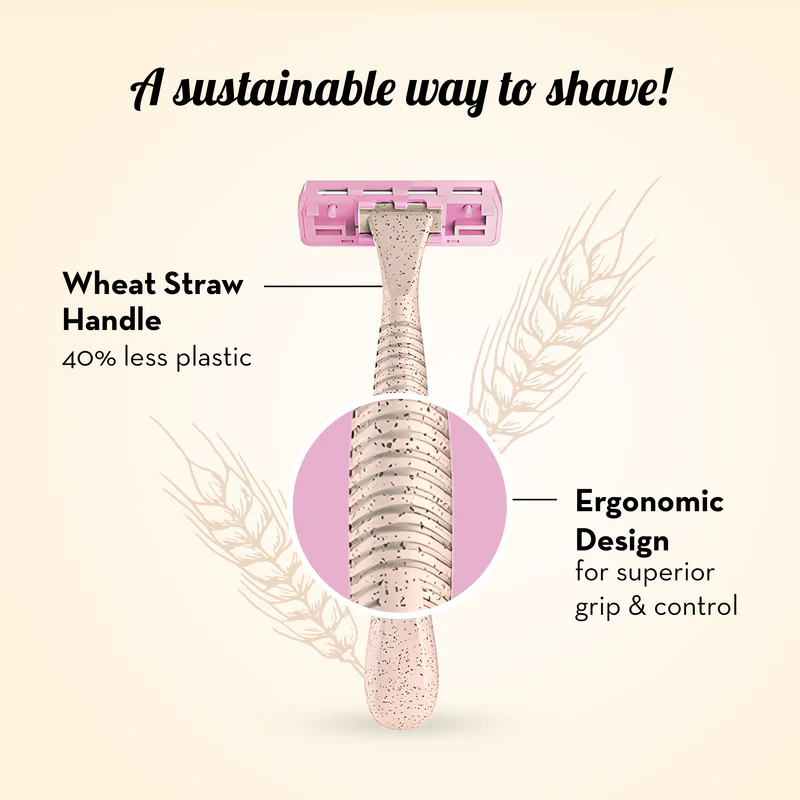
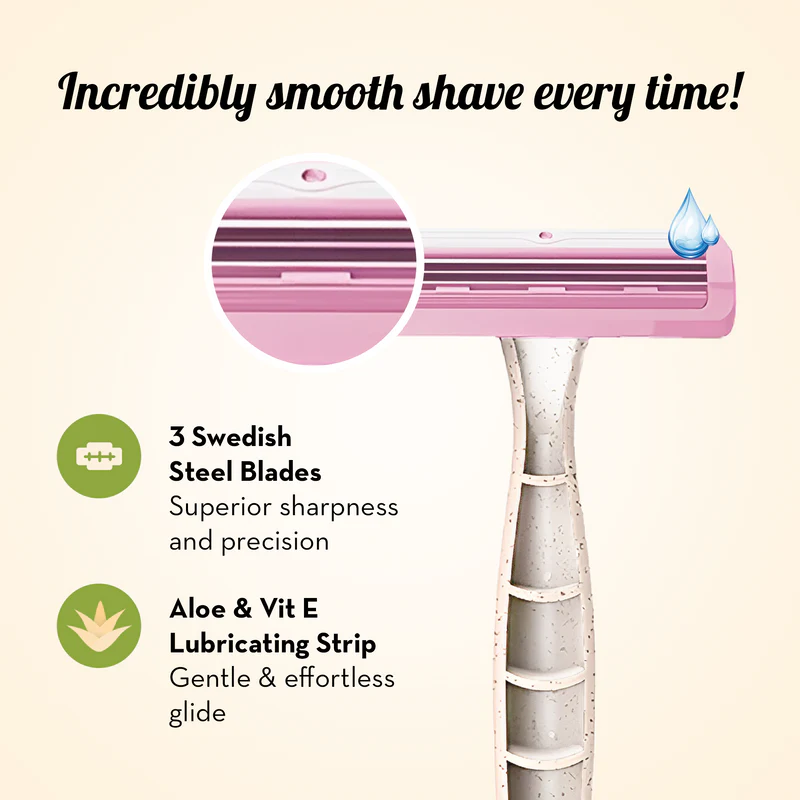
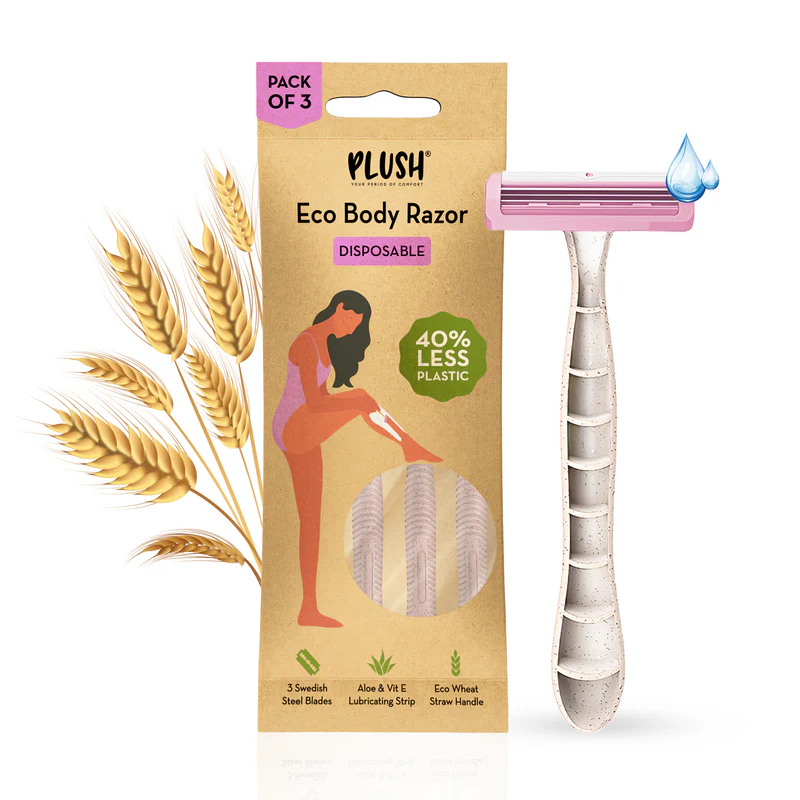
Say hello to a smooth planet friendly shave! ✨
✨Pack of 3 Eco Razors
✨ 3 Sweden steel blades
✨ Wheat Straw Handle
✨ 40% Less Plastic
✨ Aloe and Vitamin E lubricating strip
✨ Zero cuts, Zero bumps
✨ Disposable
Made with wheat straw, our 3 Swedish steel blade razor is crafted with an innovative eco handle, reducing our plastic usage by 40%. Equipped with an Aloe vera and Vit E lubricating strip, it creates a soft cushion between your skin & the blades. This eco-razor is designed for a smooth & sustainable shaving experience making it the better choice for you & the planet. No post-shaving blade clean-up needed! Just dispose of it responsibly after every shave. Eco-friendly, smooth & hassle-free! 🌿
No reviews yet. Be the first to review this product.
Ask a Question
Login to ask a question.
Sustainability of Body Razors
- Material Composition:
- Recyclable Materials: Sustainable body razors are often made from materials that can be easily recycled, such as stainless steel or aluminum. These materials can be recycled multiple times without significant degradation in quality.
- Biodegradable Components: Some razors incorporate biodegradable materials, especially in handles or packaging, reducing the environmental impact when disposed of.
- Durability and Longevity:
- Long-lasting Products: Durable razors that last longer reduce the frequency of replacement. This longevity means fewer resources are consumed over time, and less waste is generated.
- Replaceable Blades: Razors with replaceable blades extend the life of the handle, further reducing waste. Instead of disposing of the entire razor, only the blade needs to be replaced.
- Eco-friendly Manufacturing Processes:
- Energy-efficient Production: Sustainable body razors are often manufactured using processes that minimize energy consumption and reduce greenhouse gas emissions.
- Sustainable Sourcing: The materials used in these razors are sourced responsibly, ensuring that the environmental impact of raw material extraction is minimized.
Low Carbon Footprint of Body Razors
- Reduced Waste:
- Minimal Disposal: Traditional disposable razors contribute significantly to landfill waste. Sustainable razors with replaceable blades or made from recyclable materials reduce the amount of waste generated.
- Efficient Supply Chains:
- Local Production: Producing razors locally reduces the carbon footprint associated with transportation. This minimizes the emissions related to shipping and distribution.
- Streamlined Logistics: Efficient supply chains that reduce unnecessary steps and optimize transportation routes help lower the overall carbon footprint.
- Sustainable Packaging:
- Eco-friendly Packaging: Packaging made from recycled or biodegradable materials reduces the environmental impact. Additionally, minimalistic packaging designs reduce the volume of materials used.
- Reduced Packaging Waste: Less packaging waste translates to lower emissions during the production, transportation, and disposal stages.
Scientific Explanation and References
- Life Cycle Assessment (LCA):
- LCA studies show that durable products with longer lifespans have a lower environmental impact over time. For instance, a study published in the Journal of Cleaner Production highlights that products designed for durability and recyclability significantly reduce their carbon footprint throughout their lifecycle .
- Material Impact:
- According to research from the Environmental Science & Technology journal, materials like stainless steel and aluminum, when recycled, have much lower energy requirements compared to virgin materials. This reduces the carbon footprint associated with their production .
- Manufacturing and Supply Chain Efficiency:
- A study from the International Journal of Production Economics indicates that optimizing supply chains and localizing production can significantly reduce carbon emissions associated with transportation and logistics .
- Packaging Waste Reduction:
- Research from the Journal of Industrial Ecology shows that eco-friendly packaging materials and reduced packaging volumes lead to substantial decreases in the overall carbon footprint of consumer products .
By focusing on these aspects, sustainable body razors demonstrate lower environmental impact and reduced carbon footprints, contributing to more sustainable personal care routines.
- Material Extraction and Production:
- Types of materials used (e.g., plastic, metal, rubber)
- Energy consumption in material extraction and processing
- Emissions related to raw material production
- Manufacturing Process:
- Energy consumption in the manufacturing process
- Emissions from manufacturing facilities
- Waste generated during manufacturing
- Transportation:
- Distance traveled from manufacturing site to distribution centers
- Modes of transportation used (e.g., ship, truck, air)
- Emissions from transportation
- Usage:
- Lifespan of the product
- Frequency of blade replacement (if applicable)
- End-of-Life Disposal:
- Disposal methods (e.g., landfill, recycling)
- Emissions related to disposal or recycling processes
Example Calculation Approach
To estimate the carbon footprint of a hypothetical sustainable body razor, let's outline a simplified approach using available data:
- Materials:
- Stainless steel handle: ~2.9 kg CO2e per kg of stainless steel
- Plastic components (if any): ~6 kg CO2e per kg of plastic
- Manufacturing:
- Energy consumption for manufacturing: 1 kg CO2e per razor (estimate)
- Transportation:
- Local distribution: 0.1 kg CO2e per razor (short distance, efficient logistics)
- Usage:
- Lifespan of handle: 10 years
- Blade replacement every 3 months: 4 blades per year
- End-of-Life Disposal:
- Recycling of metal components: minimal additional emissions
- Disposal of plastic components: ~0.5 kg CO2e per razor
Hypothetical Carbon Footprint Calculation
Assumptions:
- Stainless steel handle weighs 100g
- Plastic components weigh 50g
Material Production:
- Stainless steel: 0.1 kg * 2.9 kg CO2e = 0.29 kg CO2e
- Plastic: 0.05 kg * 6 kg CO2e = 0.3 kg CO2e
Manufacturing:
- Manufacturing emissions: 1 kg CO2e
Transportation:
- Transportation emissions: 0.1 kg CO2e
Usage (over 10 years):
- Blade replacements: 4 blades/year * 10 years = 40 blades
- Emissions per blade: Assume 0.02 kg CO2e per blade
- Total for blades: 40 * 0.02 kg CO2e = 0.8 kg CO2e
End-of-Life Disposal:
- Disposal of plastic components: 0.5 kg CO2e
Total Carbon Footprint:
- Materials: 0.29 kg CO2e + 0.3 kg CO2e = 0.59 kg CO2e
- Manufacturing: 1 kg CO2e
- Transportation: 0.1 kg CO2e
- Usage (blades): 0.8 kg CO2e
- Disposal: 0.5 kg CO2e
Total: 0.59 + 1 + 0.1 + 0.8 + 0.5 = 2.99 kg CO2e
Conclusion
The hypothetical total carbon footprint of a sustainable body razor over its lifetime is approximately
2.99 kg CO2e. This figure can vary significantly based on specific product details, materials used, manufacturing processes, and actual usage patterns.
References:
- Journal of Cleaner Production: Study on Life Cycle Assessment of Durable Products
- Environmental Science & Technology: Research on Recyclable Materials
- International Journal of Production Economics: Study on Supply Chain Optimization
- Journal of Industrial Ecology: Research on Eco-friendly Packaging.
🔒
Full Sustainability Report
Unlock the complete AI-powered lifecycle analysis — certifications, verdict, carbon comparison & more.
✅ Usage Phase impact
✅ End-of-Life data
✅ Key Highlights
✅ Certifications
✅ Final Verdict
🌿
Want Your Own Company ESG Report?
Generate a full BRSR-aligned ESG report for your organisation — AI-powered, Gemini-backed, with a CM Carbon Rating (A–E).
🔑 Login & Calculate ESG
Offers
No offers available for this product at the moment.
Contact the vendor for bulk order pricing: Plus
Please contact the vendor directly for their specific return and shipping policies.