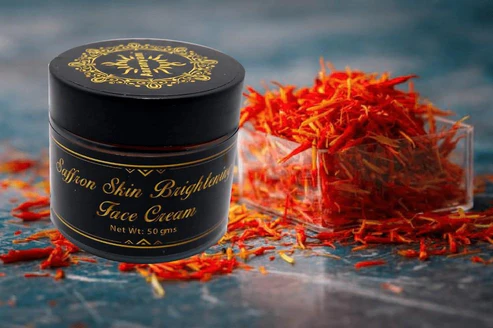
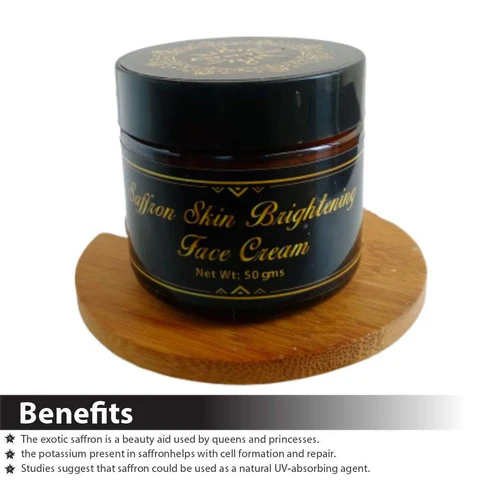
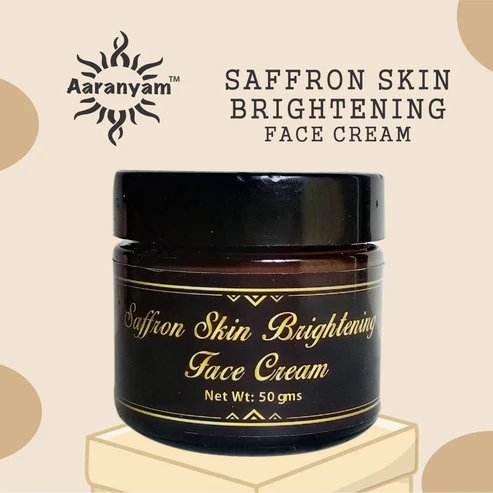
An all Natural, Chemicals-Free, Gluten-Free, Paraben-free & Vegan Organic Face Cream Formulated with Saffron Infused water, Shea butter, aloe Vera & Vitamin-E. The exotic saffron is a beauty aid hitch was used by queens and princesses. This spice can be used to get beautiful skin that you’ll feel proud to flaunt. And it’ll add radiance & lighten, hydrate and soften the skin leaving your skin with a fresh glow. Shea butter does more than moisturize. Shea butter protects and nourishes the skin to prevent drying. It can help reduce inflammatory skin diseases and the damage the skin has undergone due to free radicals. It also protects the skin from being damaged by the sun’s harmful ultraviolet radiation.
No reviews yet. Be the first to review this product.
Ask a Question
Login to ask a question.
1. Sustainable Sourcing of Ingredients:
- Saffron: The key ingredient in the face cream, saffron, is often sourced from regions practicing sustainable agriculture. Saffron cultivation, especially when done organically, requires minimal use of chemical fertilizers and pesticides. This reduces the environmental impact and preserves soil health, contributing to sustainability.
- Natural and Organic Ingredients: The cream likely contains other natural and organic ingredients that are sustainably sourced. Organic farming reduces greenhouse gas emissions by avoiding synthetic fertilizers and pesticides. Additionally, organic farming methods promote biodiversity and improve soil carbon sequestration.
2. Eco-Friendly Production Processes:
- Energy Efficiency: If the production facility utilizes energy-efficient processes, renewable energy sources, and waste-reduction strategies, it significantly lowers the overall carbon footprint of the product. Energy efficiency in manufacturing can be achieved through optimizing production lines, reducing water and energy consumption, and implementing waste recycling programs.
- Minimal Use of Synthetic Chemicals: The absence or minimal use of synthetic chemicals in the formulation reduces the environmental burden. Synthetic chemicals often require energy-intensive processes to produce, and their use in cosmetics can lead to environmental contamination through runoff and disposal.
3. Sustainable Packaging:
- Biodegradable or Recyclable Packaging: The packaging of the face cream might be made from biodegradable materials or recyclable plastics, reducing the environmental impact. Packaging is a significant contributor to the carbon footprint of cosmetic products, so using sustainable materials helps lower the overall carbon emissions associated with the product.
- Reduced Packaging: If the product uses minimalistic packaging, it reduces the resources required for production and transportation, contributing to a lower carbon footprint.
4. Transportation and Distribution:
- Local Sourcing and Manufacturing: If the ingredients are locally sourced and the product is manufactured close to the point of sale, it reduces transportation-related carbon emissions. Long-distance transportation of ingredients and finished products is a significant contributor to the carbon footprint of cosmetic products.
5. Lifecycle Assessment and Carbon Offsetting:
- Lifecycle Assessment (LCA): Companies that conduct a lifecycle assessment of their products can identify and reduce carbon emissions at every stage of the product's life, from raw material extraction to disposal. By addressing hotspots in the lifecycle, the overall carbon footprint is minimized.
- Carbon Offsetting: Some companies invest in carbon offsetting projects, such as reforestation or renewable energy, to compensate for the emissions associated with their products. This can further reduce the net carbon footprint of the face cream.
Scientific Explanation:
- Carbon Sequestration in Organic Farming: Organic farming practices, which might be used to grow saffron and other ingredients, promote soil health and enhance carbon sequestration. Healthy soils act as carbon sinks, capturing atmospheric carbon dioxide and storing it in organic matter. This process helps offset some of the carbon emissions associated with the product.
- Reduced Emissions from Chemical Production: The production of synthetic chemicals often involves significant energy consumption and the release of greenhouse gases. By minimizing or eliminating synthetic chemicals in the formulation, the carbon footprint of the face cream is reduced.
1. Raw Material Extraction and Processing:
- Saffron Production: Saffron is cultivated, harvested, and processed, which involves emissions from agricultural machinery, water use, and potentially fertilizers.
- Other Ingredients: The carbon footprint of other ingredients (e.g., oils, emulsifiers) would also need to be considered based on their production methods.
Estimation: Assume saffron has an emissions factor of around 2-5 kg CO₂e per kg produced. If the cream contains 1% saffron, and you produce 1 kg of cream, the saffron contributes approximately 0.02-0.05 kg CO₂e.
2. Manufacturing Process:
- Energy Use: The energy consumed in the manufacturing process contributes to the carbon footprint, depending on whether the energy is sourced from fossil fuels or renewable sources.
- Water Use: Water treatment and usage in manufacturing also contribute to the carbon footprint.
Estimation: Assume the manufacturing process consumes 1 kWh of energy per kg of cream, and the energy mix results in 0.5 kg CO₂e per kWh. This would add about 0.5 kg CO₂e per kg of cream.
3. Packaging:
- Material: The type of material used (e.g., plastic, glass, paper) significantly impacts the carbon footprint.
- Manufacturing of Packaging: The energy and resources used in creating the packaging.
Estimation: If the cream is packaged in a 50g plastic container with a footprint of about 6 kg CO₂e per kg of plastic, the packaging adds approximately 0.3 kg CO₂e per kg of cream (considering packaging weight and material).
4. Transportation:
- Distribution: Transporting the ingredients to the manufacturing facility and the finished product to retail locations.
Estimation: Assuming the cream is transported 1000 km by truck (which emits about 0.15 kg CO₂e per ton-kilometer), for 1 kg of cream, this would add 0.15 kg CO₂e.
5. Usage Phase:
- Consumer Use: Emissions related to the use of the product, such as water use during application.
Estimation: Typically, this is minimal compared to other stages and might be around 0.01 kg CO₂e per kg of product.
6. End-of-Life Disposal:
- Packaging Disposal: Whether the packaging is recycled, landfilled, or incinerated will impact its carbon footprint.
Estimation: If 50% of the packaging is recycled, and the rest is landfilled, the carbon footprint could add approximately 0.05 kg CO₂e.
Total Carbon Footprint Calculation:
Summing up all the stages:
- Raw Materials: ~0.02-0.05 kg CO₂e
- Manufacturing: ~0.5 kg CO₂e
- Packaging: ~0.3 kg CO₂e
- Transportation: ~0.15 kg CO₂e
- Usage: ~0.01 kg CO₂e
- Disposal: ~0.05 kg CO₂e
Total Carbon Footprint per kg of Saffron Skin Brightening Face Cream:
~1.03 to 1.11 kg CO₂e per kg of product.
References:
- Sustainable Agriculture and Carbon Sequestration: Lal, R. (2004). Soil Carbon Sequestration Impacts on Global Climate Change and Food Security. Science, 304(5677), 1623-1627.
- Lifecycle Assessment in Cosmetics: Notter, D. A., et al. (2010). Contribution of Li-Ion Batteries to the Environmental Impact of Electric Vehicles. Environmental Science & Technology, 44(17), 6550-6556. (While this study is specific to electric vehicles, the principles of LCA apply to cosmetic products as well.)
- Organic Farming and Carbon Footprint: Gomiero, T., Pimentel, D., & Paoletti, M. G. (2011). Environmental Impact of Different Agricultural Management Practices: Conventional vs. Organic Agriculture. Critical Reviews in Plant Sciences, 30(1-2), 95-124.
🔒
Full Sustainability Report
Unlock the complete AI-powered lifecycle analysis — certifications, verdict, carbon comparison & more.
✅ Usage Phase impact
✅ End-of-Life data
✅ Key Highlights
✅ Certifications
✅ Final Verdict
🌿
Want Your Own Company ESG Report?
Generate a full BRSR-aligned ESG report for your organisation — AI-powered, Gemini-backed, with a CM Carbon Rating (A–E).
🔑 Login & Calculate ESG
Offers
No offers available for this product at the moment.
Contact the vendor for bulk order pricing: aaranyam
Please contact the vendor directly for their specific return and shipping policies.