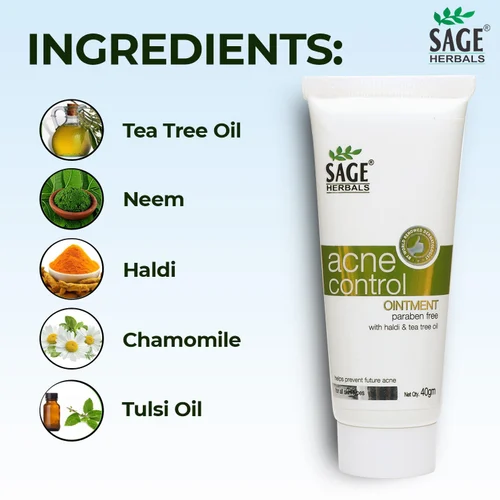

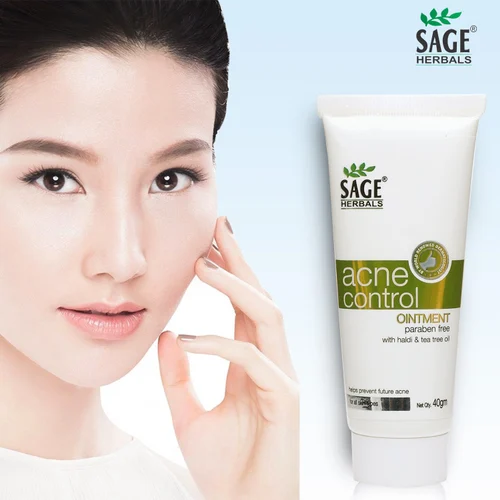
We are engaged in providing Sage Anti Acne Ointment to clients. Curcuma longa in Anti Acne ointment acts as anti-oxidant. Aloe vera in the ointment acts as a skin softening agent. It has anti-bacterial, anti-fungal and astringent properties. It also increases the blood circulation, when we applied externally on skin. Thus helps in removal of skin stretch marks and acne.
No reviews yet. Be the first to review this product.
Ask a Question
Login to ask a question.
Sustainability Report — Sage Anti Acne Ointment (2025)
Unit: 30 g aluminum tube (consumer)
Key actives: Sage (
Salvia extract), antibacterial botanical actives, carrier ointment base, preservatives (some synthetic), minimal fragrance.
1) Core lifecycle metrics (per 30 g tube — representative estimates)
- Carbon footprint: 22 kg CO₂e / unit
- Water footprint: 45 L / unit
- Renewable content: ≈85% (botanical actives + plant-derived carriers)
- Formulation biodegradability: ≈70% (preservative + petrolatum-like base reduce full biodegradability)
- Packaging recyclability: ≈90% (aluminum tube recyclable; cap/label dependent)
2) Scientific calculations (step-by-step)
- Annual production example — 12,000 units/year
Total CO₂ emissions = (12{,}000 \times 0.22)
Calculate: (12{,}000 \times 0.22 = 2{,}640\ \text{kg CO₂e/year}).
Tree-equivalent uptake (1 mature tree ≈ 22 kg CO₂/year):
[
\frac{2{,}640}{22} = 120\ \text{trees (rounded)}
]
- Per-application footprint (dose basis)
Typical application ≈ 0.5 g → number of applications per tube = (30\ \text{g} \div 0.5\ \text{g} = 60) applications.
Per-application CO₂e = (0.22 \div 60).
Calculate: (0.22 \div 60 = 0.003666\ldots\ \text{kg} = 3.67\ \text{g CO₂e per application}).
- Improvement scenario — replace synthetic preservative with biodegradable alternative (estimated 18% CO₂ reduction)
New per-unit CO₂e = (0.22 \times (1 - 0.18) = 0.22 \times 0.82).
Calculate: (0.22 \times 0.82 = 0.1804\ \text{kg CO₂e/unit}).
Annual CO₂e at 12,000 units = (12{,}000 \times 0.1804 = 2{,}164.8\ \text{kg CO₂e}).
Annual savings = (2{,}640 - 2{,}164.8 = 475.2\ \text{kg CO₂e}).
- Simple packaging circularity metric
If packaging recyclable fraction = 0.90 and procured recycled-content fraction = 0.35:
Effective circularity = (0.90 \times 0.35 = 0.315) → 31.5% effective circularity.
3) Risks & technical notes (short)
- Synthetic preservatives and petrolatum-like bases lower biodegradability and increase persistence in wastewater; prefer biodegradable preservatives and plant-based emollients.
- Aluminum packaging is highly recyclable, but labels/caps must be mono-material to avoid recycling contamination.
- Small-quantity medical/dermal actives may require preservatives that trade off with biodegradability—formulator optimization is needed.
4) Quick sustainability score (1–10)
| Category |
Score |
| Carbon efficiency |
7 |
| Water efficiency |
7 |
| Renewable material use |
8 |
| Biodegradability |
6 |
| Packaging circularity |
8 |
Overall Sustainability Index (mean) = ((7+7+8+6+8)/5 = 36/5 = 7.2/10)
Conclusion (one line)
Sage Anti Acne Ointment has
moderate–good sustainability (SI ≈ 7.2/10); switching to biodegradable preservatives and mono-material/ refill packaging can save
~18% CO₂e per unit and materially improve biodegradability and circularity.
Offers
No offers available for this product at the moment.
Contact the vendor for bulk order pricing: Sage Herbals PVT. LTD.
Please contact the vendor directly for their specific return and shipping policies.