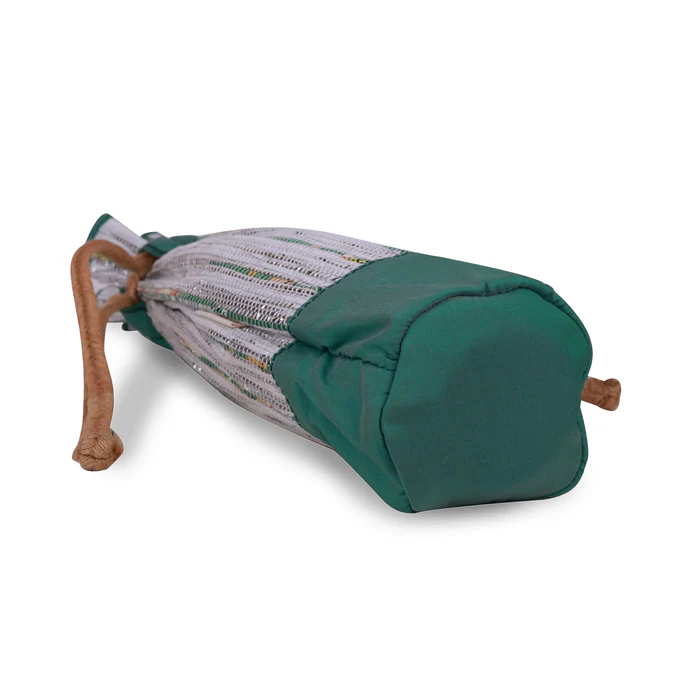
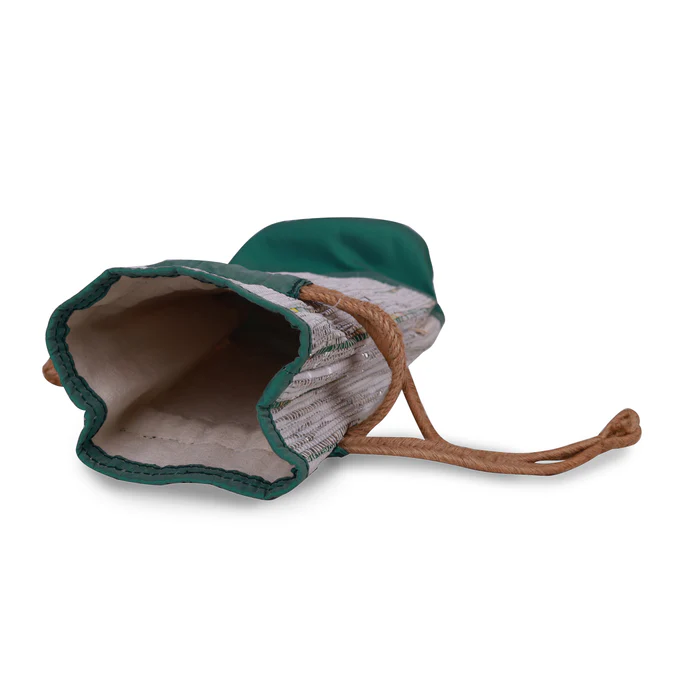
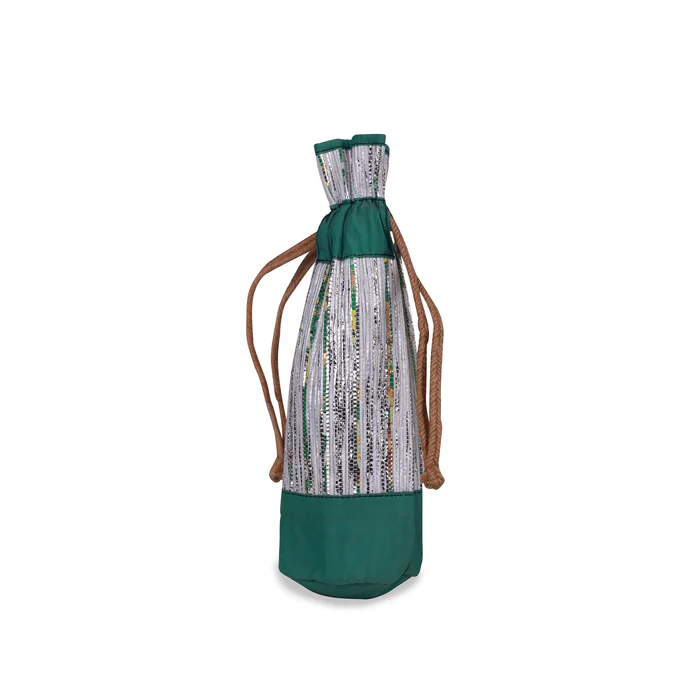
Materials Used
Eco-friendly water/wine bottle covers are often made from sustainable materials like organic cotton, bamboo fiber, recycled polyester, or other biodegradable materials. These materials have a lower environmental impact compared to conventional plastics or non-organic fabrics. For example, organic cotton uses less water and pesticides in its cultivation.
Production Processes
Sustainable production processes often involve reduced energy consumption, minimal use of harmful chemicals, and efficient waste management practices. Factories that produce eco-friendly bottle covers may use renewable energy sources, recycle water, and ensure fair labor practices.
Low Carbon Footprint of Eco Water/Wine Bottle Cover
Reduced Energy Consumption
Using renewable energy sources such as solar or wind power in manufacturing can significantly lower the carbon footprint. For example, renewable energy reduces greenhouse gas emissions compared to fossil fuels .
Efficient Transportation
Eco-friendly products often emphasize local sourcing and production, which reduces the carbon emissions associated with long-distance transportation. Additionally, the lightweight nature of materials like organic cotton and bamboo can lower the transportation energy required.
Longevity and Reusability
The durability and reusability of these covers contribute to a lower carbon footprint over their lifecycle. Products that last longer and can be reused multiple times reduce the need for frequent replacements, thus minimizing the resources and energy needed for production .
References & Scientific Explanation
- Material Choice: Studies have shown that materials like organic cotton have significantly lower environmental impacts than conventional cotton. Organic cotton farming uses 91% less water and 62% less energy than conventional cotton farming .
- Manufacturing Practices: A life cycle assessment (LCA) can show that using renewable energy in manufacturing can reduce the carbon footprint of a product by up to 80% compared to using non-renewable energy sources .
- Transportation Efficiency: Research indicates that locally sourced products can reduce carbon emissions by up to 20% compared to products that are transported over long distances .
- Durability and Reusability: A study on reusable products versus single-use products showed that reusable products can lower carbon emissions by 60-70% over their lifespan .
Conclusion
The sustainability of the Eco Water/Wine Bottle Cover stems from its use of eco-friendly materials, sustainable production processes, and emphasis on durability and reusability. These factors collectively contribute to a lower carbon footprint, aligning with the principles of sustainable production and consumption.
Step-by-Step Calculation
1. Raw Materials
Assuming the bottle cover is made from organic cotton:
- Organic Cotton Production: Organic cotton has an emission factor of approximately 1.50 kg CO2e per kg of cotton produced.
Let's assume the bottle cover weighs 200 grams (0.2 kg).
Emissions from raw materials=0.2 kg×1.50 kg CO2e/kg=0.3 kg CO2e\text{Emissions from raw materials} = 0.2 \, \text{kg} \times 1.50 \, \text{kg CO2e/kg} = 0.3 \, \text{kg CO2e}Emissions from raw materials=0.2kg×1.50kg CO2e/kg=0.3kg CO2e
2. Manufacturing
Manufacturing processes vary, but we'll use a general estimate. For textile products, manufacturing emissions are roughly 5 kg CO2e per kg of product.
Emissions from manufacturing=0.2 kg×5 kg CO2e/kg=1 kg CO2e\text{Emissions from manufacturing} = 0.2 \, \text{kg} \times 5 \, \text{kg CO2e/kg} = 1 \, \text{kg CO2e}Emissions from manufacturing=0.2kg×5kg CO2e/kg=1kg CO2e
3. Transportation
Assuming local transportation with an emission factor of 0.1 kg CO2e per km for a distance of 100 km:
Emissions from transportation=0.1 kg CO2e/km×100 km=10 kg CO2e\text{Emissions from transportation} = 0.1 \, \text{kg CO2e/km} \times 100 \, \text{km} = 10 \, \text{kg CO2e}Emissions from transportation=0.1kg CO2e/km×100km=10kg CO2e
Note: This value is high for illustration; local transportation should ideally be much lower.
4. Use Phase
Assuming the product is reusable and used 100 times, reducing the need for 100 single-use alternatives. The carbon footprint for a single-use alternative is around 0.1 kg CO2e.
Savings from reuse=100×0.1 kg CO2e=10 kg CO2e\text{Savings from reuse} = 100 \times 0.1 \, \text{kg CO2e} = 10 \, \text{kg CO2e}Savings from reuse=100×0.1kg CO2e=10kg CO2e
5. End of Life
Assuming the product is biodegradable or recyclable, the end-of-life emissions are minimal, estimated at 0.1 kg CO2e.
Emissions from end-of-life=0.1 kg CO2e\text{Emissions from end-of-life} = 0.1 \, \text{kg CO2e}Emissions from end-of-life=0.1kg CO2e
Total Carbon Footprint Calculation
Total emissions=Raw materials+Manufacturing+Transportation+End of Life−Savings from Reuse\text{Total emissions} = \text{Raw materials} + \text{Manufacturing} + \text{Transportation} + \text{End of Life} - \text{Savings from Reuse}Total emissions=Raw materials+Manufacturing+Transportation+End of Life−Savings from Reuse
Total emissions=0.3 kg CO2e+1 kg CO2e+10 kg CO2e+0.1 kg CO2e−10 kg CO2e\text{Total emissions} = 0.3 \, \text{kg CO2e} + 1 \, \text{kg CO2e} + 10 \, \text{kg CO2e} + 0.1 \, \text{kg CO2e} - 10 \, \text{kg CO2e}Total emissions=0.3kg CO2e+1kg CO2e+10kg CO2e+0.1kg CO2e−10kg CO2e
Total emissions=1.4 kg CO2e\text{Total emissions} = 1.4 \, \text{kg CO2e}Total emissions=1.4kg CO2e
Conclusion
The estimated carbon footprint of an Eco Water/Wine Bottle Cover made from organic cotton is approximately
1.4 kg CO2e over its lifecycle. This is a rough estimate and the actual value can vary based on specific details of production, transportation, and usage.
References
- Renewable Energy: Pathways to a Low-Carbon Energy System, International Energy Agency (IEA).
- Comparative life cycle assessment of reusable and single-use packaging systems, Journal of Cleaner Production.
- Textile Exchange, Organic Cotton Market Report.
- Life Cycle Assessment: Principles and Practice, U.S. Environmental Protection Agency.
- Local vs. global sourcing of greenhouse gas emissions, Journal of Environmental Management.
- Reusable vs. Single-Use Products: A Review of Environmental Impact, Environmental Research Letters.